Post # 39: Ensuring healthy edible oil consumption: Part II – Wrapping up the entire ‘oil consumption’ narrative
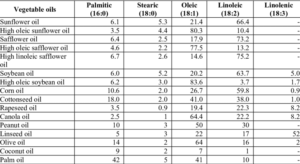 The fixed composition of oils vs. the consumption recommendations: The idea of ‘ideal’ oil consumption is a relatively recent construct that stemmed from the developing insights in our physiology, especially metabolism. As already noted, it immediately got complicated because of the immense variety in body types and, within each, variables like environmental factors, heredity, pre-existing conditions, physical activity levels etc. This was largely circumvented by basing those quantity recommendations on the individual’s ‘calorie requirement’, tacitly factoring in most variations stemming from lifestyle, health status and most disease conditions.
But, obviously, calorie-based recommendations cover quantities; the issue of provisions of EFA remains unaddressed. At the very least, the essential fatty acids – the EFA – must be covered in the right proportions because our body cannot convert available constituents into them. A saving grace in this confusing minefield is the somewhat unconfirmed ‘essentialness’ of EFA. Apparently, even without conscious seeking out of EFA-rich oils for visible consumption, EFA requirements are taken care of adequately enough thru dietary routes to not precipitate disease conditions. But frankly, this is a grey area because one can live ‘below par’ for years without realizing that he is missing anything.
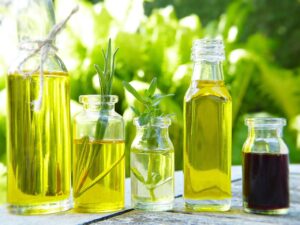 Edible oils are nature’s products (like us, human beings) and each oil has its own fatty acid composition which is pretty much fixed barring negligible variations. And nature designed each oil with Her vision, not with the responsibility of ensuring that any given oil will take care of all man’s nutritional requirements when they are eventually formulated by ‘authorities’. In other words, no single oil has ready-made PUFA-MUFA composition that will complete anyone’s requirement simply by limiting the quantity.
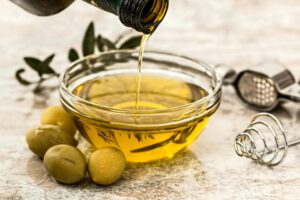 So we should be happy if EFA are adequately supplied by the diet as a measure of abundant precaution. In plainer words, the wide-spread recommendations for MUFA – basically oleic acid – are confusing. If an individual consumes oil/fat quantities to cover EFA in the right proportions, the widely distributed oleic acid is unlikely to become scarce. And it is not ‘essential’ in any case, though some ‘heart-friendliness’ has been attributed to oils like oleic acid without explicit nutritional credit to oleic acid. You see, oils carry potent and versatile anti-oxidants, especially the unrefined ones. ‘Extra virgin’ olive oil is an unrefined oil with excellent oxidation resistance and hence keeping quality. Anyway, for the record, my olive oil is unrefined (double filtered) groundnut oil. Thank you.
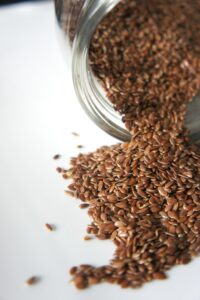 Long chain PUFA (Docosahexaenoic acid or DHA and Eicosapentaenoic acid or EPA) are actually produced from the EFA in our body and hence no separate requirement for them exists. However, flaxseed oil is a good and economical common source but use it with caution that has been described several times in these posts (especially the one concerning the ‘dark side of oxygen) – best avoided unless specifically recommended by the physician and if you are confident of using it smartly.
Note that saturated fatty acids (SFA) are the remaining fatty acids (SFA + MUFA + PUFA = total fatty acids) and hence stipulating the quantities of SFA also becomes confusing. Including linoleic and linolenic acids itself may bring in oleic acid as MUFA and vice versa. And either of these choices will bring in SFA. Thus simultaneous compliance with all types of fatty acids with available oils may be difficult for the layman and the home maker. Ironically, the SFA were considered harmful (‘bad for the heart’ mainly) almost till the end of last century, though not anymore. Thus forgetting the SFA requirement is fine. It is for this reason that we have provided a simplified formula later in this post that will work satisfactorily. And, most importantly, be implementable.
A glimpse of calorie requirement-based recommendations:
Here’s a brief demo of how you can judge your oil consumption, if you are so inclined.
 Step I: A 3300 cals/day requirement in a sporty 20 year old male.
Step II: This high calories requirement can be strategically provided by a higher proportion of oils/fats (milk and its products and nuts apart from dishes cooked in preferred oils) exploiting the high calorie density of oils/fats. What this will do is: sufficiently large ‘volume’ of non-oil food is left to cover his protein and carb requirement among macronutrients. Hence 1/3 (less for the sedentary) of 3300 i.e. 1100 is his calorie requirement from oils/fats – visible and invisible, at home and away.
Step III: Oil requirement = 1100/9.2 = about 120 grams/day.
Step IV: Distributing 120 grams of oil/day.
This guy needs good milk (and milk product) and nut consumption for the simultaneous fulfillment of calorie and protein requirement. Add to this is ‘away from home’ invisible oil consumption.
Typically half liter of milk/curd (two glasses) brings in about 25 grams of fat and 100 grams of mixed nuts, about 45 grams. Let’s assume that this is total invisible oil consumption.
Therefore visible oil requirement/day = 120 – 25 – 45 = 50 grams i.e. annually, about 18 kgs – as uniformly distributed as practically possible. Note Yatin’s consumption of 14 kgs/year is less; he may be less physically active but can still consume more of butter, cheese and sweets at home. (Ref post no.37a. Ensuring healthy edible oil consumption: Part Ia – Quantity).
Step V: Breakdown of 50 grams into PUFA, MUFA, SFA.
Let’s see what a 1:2 proportion of refined soybean oil and unrefined groundnut oil (in 50 grams/day) will do. It will bring in about 1.9 g linolenic acid and about 19 g of linoleic acid taking care of PUFA. This is an excellent optimization-cum-simplification.
Ref the following posts:
(1) No. 17: Edible oils: An introduction.
(2) No. 19: The physiological functions of edible oils.
(3) No. 35: Ideal oils for each cooking mode.
(4) No. 36: Selecting specific oils for specific cooking.
(5,6) Nos. 37 and 38: Ensuring healthy oil consumption, Parts I and II.
The suggestion for a typical Indian family:
 Judge the calorie requirement of each member.
- Assign calorie weightage to oils/fats; usually the more the physical activity, the greater the apportionment of requirement to oils. Typically between 25% and 35%.
- Derive total oil quantities divide between visible and invisible. Assume all visible consumption to be ‘at home’.
- Distribute oil quantities between your favorite refined and unrefined oils. Typical examples: 1. Unrefined groundnut oil and refined soybean oil. 2. Unrefined coconut oil and refined sunflower oil. 3. Unrefined mustard oil and refined cottonseed oil.
What do we Trivedi’s do?
- Our eating out and ordering out is mainly situation-based and rare. Rarely do we go out just to eat.
- Our bought out consumption of oily processed foods (fried snacks, biscuits) is very limited.
- We consume milk, cheese, butter, nuts freely, rarely flaxseeds.
- We minimize frying at home. Our consumption is mainly by way of cooked subji dishes and daals. We rarely apply ghee to our roti/chappati. Our consumption of smear-fried paratha is high.
- Our visible oils are unrefined groundnut oil and refined soybean oil in rough 2:1 proportions.
Summary:
- How much total oil/fat every member of a family actually consumes today is as difficult to judge as it is essential to know.
- It can be done fairly reliably and, that it is not totally accurate, should not deter approximation because it can be a critical determinant of physiological parameters (mainly blood lipid profile) which indicate present and imminent serious disease conditions.
- The ‘recommended’ quantities of oils to be consumed, depend on a lot of factors – all known – and actual consumption should be nudged towards it.
- The PUFA and MUFA recommendations are equally important and must be superimposed on the recommended quantities, i.e. an individual’s oil consumption must include PUFA and MUFA in the right proportions in his prescribed quantity. Since PUFA and MUFA are parts of oils, this amounts to incorporating specific oils which bring in these fatty acids, in quantities that fulfill all requirements. This is not half as complicated as it sounds once you make your mind to latch on to good health and happiness using simple but scientific tricks. Obviously, there is no need for stipulation of SFA (which were ‘tainted’ just a few decades back); whatever comes in with your PUFA is welcome. Ditto oleic acid or MUFA.
- Tracking actual oil consumption by each member of the family in minute detail is quite easy and forms the basis of corrections.
- Well-meaning ‘authorities’ have laboriously laid out how much oil an individual should consume (and of what type) but, in being meaningful, they become quite daunting for a layman. Also, delivering advice in MUFA, PUFA, SFA terms can daunt the layman even more as he buys oils, not free fatty acids. The layman can be excused for excusing himself!
- There is, therefore, dire need for an easy-to-follow guideline that is still meaningful and hence beneficial. Such a guideline, in combination with parallel tracking of parameters like BMI, blood lipid profile, fasting and post-prandial blood glucose along with HbA1C, blood pressure etc. are effective improvers of experienced life quality.
In an interesting and informative diversion we next dive into the world of ‘Technology’ taking the specific case of hydrogenation of edible oils for food applications. This will cover, inter alia,
- What is technology? How does it evolve?
- How was the technology of edible hydrogenation born and what was its evolution trajectory? What is its present status?
- The problems with our present understanding of its kinetics and how to address most of them. What will be its benefits.
- What happens when an oil is hydrogenated and how to measure the utility of the product.
- How the process can be tracked and how such tracking can lead to discovery of instantaneous IV during hydrogenation if certain protocols are followed.
- How hydrogenation of oils is a powerful tool to teach complex aspects of multiphase reactions.
As a reward for staying with this train, we also describe several innovatively developed methods, mathematics and protocols – all based on fundamentals (I cannot go much beyond that anyway!) – that show how a little imagination can be blended with past on-the-floor experience of hydrogenation to develop new insights and uses of hydrogenation. This is meant to be a part of ‘save hydrogenation’ campaign!
Next Post:
Demystifying ‘Innovation’ and ‘Technology’ – How technology evolves thru Science push and Market pull
Visit Disclaimer