Post # 44: Technology of hydrogenation of edible oils for food uses – IV : The present status of the technology and its products
After enjoying popularity as a purposeful oil modification technique for decades, nature ultimately caught up with man’s audacity in changing the nature of edible oils thru hydrogenation. Today, you are not smart and health-aware enough if you don’t bristle at the mention of TFA even if you otherwise continue to consume fried bought outs containing spurious and harmfully altered oils, air-fry extensively at home, imbibe significant quatities of synthetic anti-oxidants, ignore your rising BMI and stay unaware of your blood lipid profile and other health-indicators.
TFA – the distinguishing ‘taint’ of hydrogenated oils
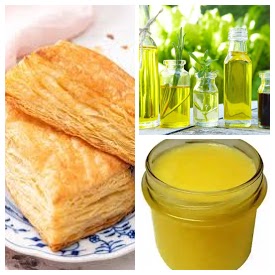 As we have seen, TFA formation is the result of half-hearted or failed attempt of natural cis double bonds in edible oils to get saturated on the catalyst surface. But it is rampant enough even in controlled hydrogenation, to be the main ‘entry point’ of TFA into our diet. The vegetable oils (groundnut, til or sesame, soybean, cottonseed, rice bran, canola, olive, sunflower, corn, palm) contain negligible traces of TFA in their natural form. Ghee (anhydrous milk fat) is the only natural fat being consumed, with up to 5 % TFA but its consumption levels are so low that they are unlikely to cause harm. Interestingly, their origin in ghee is also the result of enzymatic hydrogenation of unsaturated fatty acids in animals. Not surprisingly, mother’s milk contains TFA.
TFA formation is simply a catalyst-mediated distortion of the natural cis double bonds. As a temperature (or ∆Ea) mediates distortion, it also happens nominally during deodorization of oils i.e. the original negligible TFA content of the oil being refined is raised marginally – to the order of up to 1 % – not alarming. The fact that this happens to a negligible extent even with ‘holding time’ when both the temperature and the ‘reactant concentration’ (as in soybean oil) are high, implies absence of convenational catalyst.
 This ‘holding at high temperature’, makes ‘thermal bleaching’ possible. So is thermal bleaching desirable? Or, is there need for real cost-benefit analysis of bleaching per se’? Have we conditioned ourselves into treating bleaching as ‘essential’, resulting in the consumers treating light colour as a sign of ‘good oil’ despite the accompanying nutrient and preservative stripping? And what about the massive potentially avoidable fossil fuel consumption and GHG emissions?
An offshoot: specially designed deodorizers are on offer that minimize TFA formation – a feature that inevitably adds capital as well as operating costs. Has ‘technology’ fallen into ‘can tech, will take’ or ‘can do, will do’ trap, subliminally heaping costs of all kinds for spurious gains? If high temperature–holding time combination is to be exploited, doesn’t physical refining offer more robust net benefits, even if it compels research into more efficient degumming? Do read up an ancient Russian story titled ‘Czarina’s violet’. Points to ponder that deserve to graduate to ‘points to debate’.
Thus hydrogenated oils (and products/dishes made with them) must take the blame for being a major source of TFA in our diet. Since their hazardous nature has been determined by well-meaning ‘authorities’ who are unlikely to have axe to grind in promoting or banning hydrogenated oils, the dietary restrictions must be accepted. Important: hydrogenation of edible oils has not been banned; only restrictions have been imposed on the TFA levels in oils and food products meant for human consumption. This has obviously severely restricted the application of the process.
A bold contrarian view:
Hydrogenation of edible oils for food uses as a process and hydrogenated oils as products have key uses, TFA notwithstanding. Quite a few reasons for this audacity:
- Strategic food uses: (i) A rarely noticed fact about hydrogenation of even high IV oils (like soybean) is that the process starts with practically zero TFA which start building up with the drop in IV. A competition ensues between TFA formation and their hydrogenation and the net d[TFA]/dt is the difference between these rates. The former is a function of [cdb] which is decreasing from its initial peak and the latter, of [tdb] which increase in the initial stages thru isomerization in parallel to hydrogenation.
Obviously, the [tdb] level has to peak and then go thru a low negative slope routine till it becomes zero at full hydrogenation. An elegant technique can be perfected to approximately locate such a maxima externally, during live commercial hydrogenation. It can work even with severely partial hydrogenation i.e. at ∆I at a small fraction of Io because the reduction in tdb has to be drawn out (reducing [tdb]/dt) given the fast reducing [cdb] (going mainly into sdb) and high ∆Ea of tdb hydrogenation.
Of course, it can also be done for a specific, standardized hydrogenation cycle thru periodic sample drawals, analysis etc. followed by creation of a standard or reference curve with time or hydrogen consumption on the x axis and locating the maxima on it. But this protocol has its own negatives. (Note: trans double bond or tdb is not the same as TFA; a single TFA can carry more than one tdb. Thus [tdb] is mols of trans double bonds per liter and not the ‘level’ of TFA in grams/kg etc. Obviously, always, [tdb] > or = [TFA]). `
(ii) a partially, trans-suppressively hydrogenated oil can be blended with totally unhydrogenated (natural) oil to arrive at a blend with a fair oxidation resistance with presence of MUFA and, even, PUFA and acceptable TFA. This can mimic a naturally low IV oil but the latter would need to be expensive and the former, abundant for this to work.
– an extensively hydrogenated oil to low IV (say, 20) and negligible TFA can be blended with totally unhydrogebated oil in different proportions to get a series of functional fats.
– Soybean oil can be carefully partially hydrogenated (and blended) to an attractive CLA (conjugated linoleic acid) level with acceptable TFA. This would obviously be a very economical way of delivering the otherwise expensive CLA as a cooking oil.
 Low pollution potential: Hydrogenation is minimally polluting as we will see in the next post and is poised to be even less so with the advent of ‘green hydrogen’ which itself will be a ‘sidestream’ of the massive ‘green ecology’ campaign.
- As a specialized training tool: The reaction (and the process around it) is an interesting tool to train chemical engineers and food technologists in the nuances of ‘Heterogeneously catalysed multi-phase complex reactions’ where the analysis of the product as a whole (and its food utility) can be an indicator of the trajectory of the reaction. This, in turn, would be an insightful indicator of the mass transfer and kinetic phenomena with both potentially leading to useful insights in diffusion phenomena, catalyst physicalities, activity and selectivity, reaction molecularity and order.
- While hydrogenation of mainstream oils to produce ‘Cocoa Butter Equivalents’ (CBE) remain under a cloud because of TFA content, this is still an attractive product actually blended with cocoa butter at 5% leading to ‘moulded bar chocolate’. Obviously, ‘compounded chocolate’ formulations are possible with zero cocoa butter but necessarily trans-free fat stocks. Full hydrogenation (to nearly zero IV) of coconut and palm kernel oils followed by fractionation is a viable way of producing cocoa butter substitutes. I hereby predict proliferation of ‘middle of the market pyramid’ compounded chocolates.
Vanaspati – the Indian version of hydrogenated oil product
To the immense credit of world’s largest FMCG company – Unilever, its Indian subsidiary, HUL, (then called Hindustan Lever Ltd. – HLL) was the first to make and market vanaspati in India. So dominant was their product’s hold over the market that ‘Dalda’ (their brand name) became the alternative name of the generic product. Eventually, of course, dozens of Indian businesses started making and marketing the product, some of them surpassing the Dalda volumes. It was a blend of several hydrogenated oils (mainly soybean, cottonseed, palm, mustard/rape) and 5% unhydrogenated sesame oil as a chemical marker to enable detection of vanaspsti in desi ghee as an adulterant.
Of course, its close resemblance to desi or dairy ghee was too tempting to be ignored as a potential adulterant. At its peak, close to a million tonnes of imported oils (channelized by the government) went into making vanaspati annually. Smart home makers and halwai’s exploited its bland nature and oxidation resistance to make shelf-stable dry snacks as well as sweets where it served to spare desi ghee. Its most sought after physical version was a the grainy mass closely bound to some liquid reminiscent of desi ghee under right conditions. Later, vit A & D concentrate became mandatory to add to vanaspati as a ploy to mitigate vit deprivation in poorer sections. Later still, of course, vanaspati production declined to a trickle.
Can it be revived? Does it deserve to be revived? Points to ponder!
Other evolutionary developments in hydrogenation of oils
- The development of the ‘Loop Reactor’ already described earlier.
- The continuous mode of hydrogenation.
- The highly automated and computerized mode of ‘ultramodern’, excessively fast, ‘forced to meet the deadline’ hydrogenation.
A daydream: a preferentially trans-hydrogenating catalyst!
Next Post:
Technology of hydrogenation of edible oils for food uses – V
Complexity of the reaction, its implications and applications
Visit Disclaimer